


Introduction
The gurpreet singh calgary student demonstration has become a focal point in a much larger Canadian debate about international students, post-graduation work permits, immigration enforcement and the right to peaceful protest. What began as a dispute over work-permit eligibility in Calgary has developed into a national controversy after immigration authorities checked the status of people attending a student demonstration and, according to advocacy organizations, issued removal orders to 10 participants.
At the centre of the story is Gurpreet Singh, a 29-year-old international graduate from India who studied in Calgary. Singh and other graduates say they entered their programs believing they would have a pathway to a Post-Graduation Work Permit, commonly known as a PGWP. After completing their studies, however, their applications were refused, with the eligibility of their programs becoming a central point of disagreement.
The dispute is complicated because Canada’s PGWP system has undergone significant changes. Federal rules introduced in 2024 created new requirements for many students in non-degree programs, while government guidance also distinguishes students according to when they applied for their study permits and when they submitted their work-permit applications.
Against that backdrop, the Calgary demonstration became more than a campus or immigration dispute. It raised a difficult question: how should Canada balance immigration enforcement with the fundamental right of people living in the country to express their grievances peacefully?
1. Who Is Gurpreet Singh and Why Did He Join the Calgary Demonstration?
Gurpreet Singh is one of the international graduates whose experience became closely associated with the Calgary protest. Reporting on the dispute identifies him as a 29-year-old graduate from India who came to Canada as an international student. He completed a program connected with Portage College and later applied for a post-graduation work permit. His application was refused, and he joined fellow graduates who were demanding that authorities reconsider their situation.
For Singh and the other students, the disagreement was not simply about receiving permission to work after graduation. It was about expectations that had shaped major personal and financial decisions. Students say they enrolled after being led to believe that their programs would provide access to a PGWP pathway. Advocacy groups say the affected programs were understood to be eligible when students enrolled, and that some earlier graduates from similar programs had received work permits.
That distinction matters. An international student does not choose a Canadian college program in isolation. Tuition can represent a major investment, while moving countries also involves accommodation, transportation, employment, family support and the expectation of building a future after graduation. When eligibility rules change or are interpreted differently after students have committed themselves to a program, the consequences can reach far beyond an ordinary administrative decision.
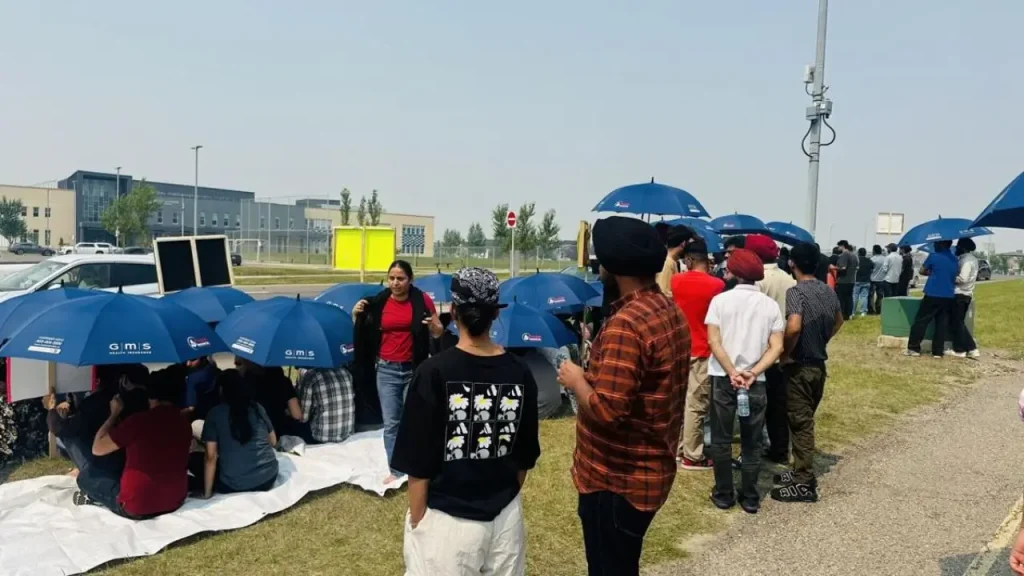
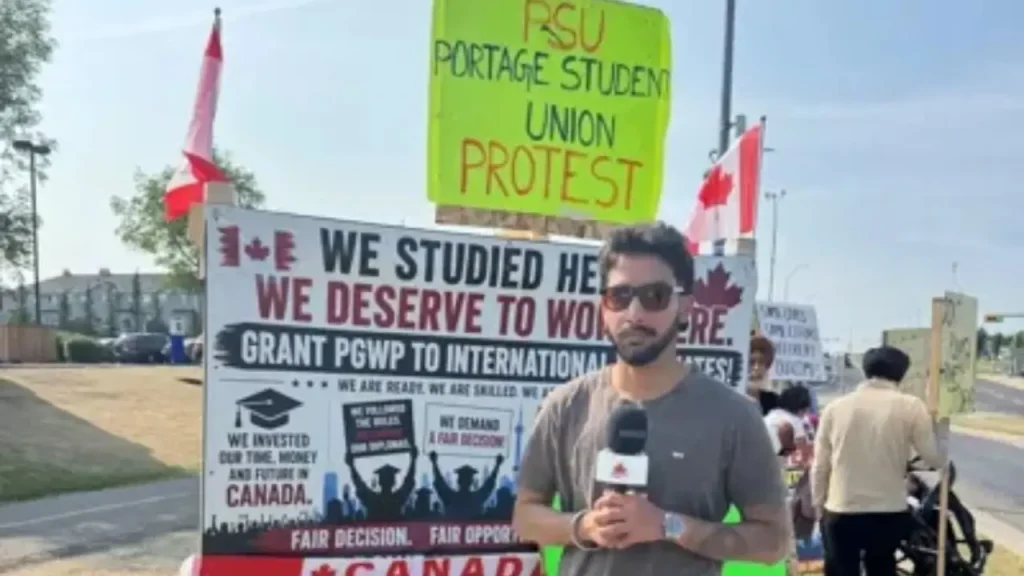
The students therefore organized demonstrations in Calgary and Edmonton. According to migrant-rights organizations, the Calgary group eventually established a round-the-clock protest near the educational institution connected with the disputed programs. The demonstrations were intended to draw attention to the work-permit refusals and pressure authorities to reconsider the affected graduates’ cases.
A Personal Dispute Became a Public Issue
Singh’s story gave the broader dispute a human face. Behind the legal terminology surrounding eligibility, applications and immigration status was a graduate trying to understand why the pathway he believed he had entered had apparently changed.
That is why the demonstration attracted attention beyond the immediate group of students. Supporters argued that the students were not attempting to evade immigration rules; they were protesting what they believed was an unfair application of those rules. Critics and authorities, meanwhile, have emphasized that temporary residents remain subject to the conditions attached to their immigration status.
Both perspectives are important when assessing the dispute. A protest does not automatically resolve whether someone is legally eligible for a work permit. At the same time, the existence of an immigration dispute does not by itself answer whether a person should be prevented from publicly challenging government policy.
2. Why Were the Students’ Post-Graduation Work Permits Refused?
The work-permit controversy sits within a broader restructuring of Canada’s international-student system. The federal government changed PGWP eligibility requirements beginning in 2024, with new rules affecting students in non-degree programs. For many applicants, eligibility can depend on factors including the date of the study-permit application, the type of credential obtained and, where applicable, whether the program falls within an eligible field of study.
One especially important date is November 1, 2024. Canada’s current guidance says students who applied for their study permit before that date generally do not have to meet the newer field-of-study requirement, while students applying on or after that date for many non-degree programs must graduate in an eligible field. The rules also contain separate provisions depending on the level and type of education completed.
| Detail | Information |
|---|---|
| Article Topic | gurpreet singh calgary student demonstration |
| Main Category | News |
| Subcategory | Canada News / Immigration News |
| Article Type | Current Affairs / Student Demonstration |
| Main Focus | Calgary student protest, Gurpreet Singh, PGWP dispute and immigration enforcement |
| Location | Calgary, Alberta, Canada |
| Target Audience | International students, Canadian immigration readers, graduates and general news readers |
| Article Length | 1400+ words |
| Headings | 5 detailed headings |
| FAQs | 10 |
| Writing Style | Informative, professional and engaging |
| Primary Topic | Student protest and immigration controversy |
| Best Website Category | News |
The Calgary students’ argument is that their circumstances should be considered according to the rules and information that existed when they enrolled. Advocacy organizations say the programs at issue were considered eligible for PGWPs when affected students began their studies. They further argue that later treatment of the programs left students caught between expectations created at enrolment and a subsequent interpretation of eligibility.
The terminology surrounding “non-credit” programs has become particularly significant in the dispute. Advocacy groups contend that Immigration Canada added language concerning non-credit programs to its public guidance in June 2026 and used that interpretation when refusing applications. They argue that students who had already enrolled should not have been disadvantaged by a later interpretation.
The Broader PGWP Policy Shift
Canada’s policy changes were not designed specifically around the Calgary students. The federal government has said its reforms are intended to better align international education with labour-market needs and Canada’s immigration objectives. Since November 2024, many graduates of non-degree programs have faced language and field-of-study requirements that did not apply in the same way under the previous system.
The federal government has also changed the list of eligible fields. In June 2025, 119 fields were added and 178 were removed, with eligibility tied to occupations experiencing long-term shortages. The list was updated again in July 2025, and the current federal guidance states that there will be no additions or removals to the eligible field list during 2026.
These changes illustrate why timing is crucial. Two students studying seemingly similar programs can face different outcomes depending on when they applied for their study permits or work permits and which rules applied to them. For international students, understanding those dates can be just as important as understanding the course itself.
In the Calgary dispute, that complexity has contributed to frustration. Students say they made substantial financial commitments based on information available when they enrolled. Government authorities, on the other hand, operate under the immigration legislation and policies in force when applications are assessed. The resulting disagreement is therefore both personal and administrative.
3. What Happened During the Calgary Student Demonstration?
The most controversial moment came on August 12, 2026. According to the Canada Border Services Agency’s account as reported in coverage of the incident, Calgary police requested an immigration-status check involving people at the demonstration. CBSA subsequently became involved and conducted further status checks. Reports say immigration status was checked for 20 people, with 12 referred for additional investigation.
Advocacy organizations say 10 people were subsequently issued removal or exclusion orders. Amnesty International Canada reported on September 2 that more than 250 organizations were calling for an independent investigation into the events and demanding that the removal orders be suspended.
Singh was among those identified in reporting as having received an order. Reports describe his situation as particularly difficult because his immigration position was already connected to the unresolved work-permit dispute. According to reporting on the case, he had been considering ways to maintain legal status in Canada when the enforcement action occurred.
The episode transformed the nature of the protest. Before August 12, the students were primarily challenging decisions concerning their post-graduation work permits. After the CBSA intervention, the debate expanded to questions about whether immigration enforcement at a protest could have a chilling effect on migrants who want to exercise freedom of expression and peaceful assembly.
Why the Enforcement Question Is So Sensitive
The controversy is not based on the proposition that immigration law should disappear at the doors of a protest. Temporary residents remain subject to Canadian immigration law. CBSA states that foreign nationals are expected to comply with the conditions of their stay and leave Canada when their authorized period ends unless they have obtained an extension or another valid status.
The more difficult question concerns the circumstances in which immigration enforcement is initiated. If people believe that attending a lawful demonstration can expose them to immigration checks, they may decide not to participate even when they have a legitimate grievance. That is the concern raised by the organizations supporting the Calgary students.
More than 250 organizations have publicly called for an independent investigation. Their demands include examining the actions of Calgary police and CBSA, suspending the removal orders, establishing clear policies around peaceful protest and finding a resolution for the affected Portage students under the rules they say applied when they enrolled.
The organizations’ position does not settle the legal dispute. An independent investigation would be significant precisely because it could establish what happened, why the police contacted federal immigration authorities, what information was available at the time and how subsequent enforcement decisions were made.
4. The Debate Over Protest Rights and Immigration Enforcement
Canada’s Charter of Rights and Freedoms protects fundamental freedoms including freedom of expression and peaceful assembly. The legal and political debate surrounding the Calgary demonstration centres partly on how those protections interact with the distinct legal obligations attached to temporary immigration status.
Supporters of the students argue that fundamental rights should not become effectively conditional on immigration status. The Migrant Rights Network and Amnesty International Canada have emphasized that migrants, international students and other non-citizens are part of Canadian communities and should not be discouraged from participating in peaceful political activity.
The issue becomes especially sensitive when a protest concerns government policy itself. If international students are affected by immigration rules, they have a direct interest in how those rules are created and administered. Preventing them from speaking about those rules would leave the people most affected by a policy with fewer practical avenues to challenge it publicly.
At the same time, freedom of assembly does not automatically create immigration status. A person may have a right to express an opinion while still being required to comply with the conditions of their temporary status. That distinction is essential to understanding the controversy without turning it into a simplistic argument that either immigration law or protest rights must completely prevail.
The Need for Clear Boundaries
One of the clearest themes emerging from the Calgary case is the need for predictable boundaries. Students should be able to understand what participation in a peaceful demonstration means for them. Police and immigration officers should likewise have clear procedures governing when immigration-status information can be requested or shared in connection with demonstrations.
The organizations supporting the students are specifically asking for such clarity. Their campaign calls for rules ensuring that peaceful protests and other protected political activities do not themselves become triggers for immigration enforcement.
Clear boundaries would serve more than one group. They could protect migrants from unnecessary fear while also giving law-enforcement and immigration authorities a consistent framework. A transparent process can reduce suspicion on all sides and make it easier to distinguish ordinary peaceful activism from situations involving genuine immigration or public-safety concerns.
The Calgary incident therefore raises a broader institutional question: how can governments enforce immigration law without creating the impression that political participation itself is dangerous for people with temporary status?
That question is likely to remain relevant as Canada continues to rely on international students while simultaneously tightening its immigration and temporary-resident policies.
5. What the Gurpreet Singh Case Could Mean for International Students
The dispute involving Gurpreet Singh is significant because it demonstrates how quickly an education decision can become an immigration crisis. A student may arrive with one understanding of a program, complete the coursework, pay tuition and then discover that the expected post-graduation pathway is no longer available.
For future students, the case offers a practical lesson: immigration eligibility should never be treated as an informal promise. Students should carefully examine the official rules applicable to their specific program, institution and application dates. Canada’s current PGWP guidance makes clear that eligibility can depend on study-permit timing, credential type, language requirements and, for certain students, the field of study.
Students should also keep copies of the information they relied upon when making educational decisions. This can include enrolment documents, institutional communications, program descriptions and correspondence about immigration eligibility. Such records do not automatically guarantee a favourable immigration outcome, but they can become important when a dispute concerns what students were told or what eligibility rules applied at a particular time.
The case also demonstrates the importance of acting quickly after a refusal. Immigration matters can involve strict deadlines and complicated procedural choices. Someone facing a refusal or removal order may need qualified legal advice to understand available remedies, rather than relying on social-media discussions or informal advice from other students.
A Test of Trust in Canada’s International Education System
There is also a larger institutional issue. Canada’s international education system depends heavily on trust. Students coming from abroad must believe that the education they are paying for will be delivered as advertised and that major policy changes will be communicated clearly.
Government policy, however, must also remain capable of changing. Labour-market needs evolve, immigration levels change and governments may decide that some educational programs are no longer aligned with national priorities. The challenge is deciding how those changes should affect students who committed themselves under an earlier policy environment.
That is why transitional arrangements matter. A policy can be legitimate while still producing harsh consequences for people who acted reasonably under an earlier set of expectations. Policymakers therefore face a difficult balance between enforcing new rules and ensuring that students already enrolled are treated fairly.
The Calgary dispute has brought that balance into sharp focus. Advocacy groups say as many as 1,500 graduates may be affected by the program-eligibility controversy and report that many students paid substantial tuition before their applications were refused.
Whether every affected graduate ultimately qualifies for a PGWP is a separate question. What is clear is that the dispute has exposed the consequences that can follow when immigration rules, institutional representations and student expectations do not align.
Conclusion
The gurpreet singh calgary student demonstration is not simply the story of one student’s unsuccessful work-permit application. It is a complicated case involving international education, changing Canadian immigration policy, administrative decision-making and the rights of migrants to participate in public protest.
Gurpreet Singh and his fellow graduates argue that they entered their programs with legitimate expectations about their post-graduation options. Their work-permit refusals led them to demonstrate, and the August 12 CBSA intervention transformed the dispute into a much wider debate about immigration enforcement and peaceful assembly. Advocacy organizations say 10 participants received removal or exclusion orders and more than 250 organizations have called for an independent investigation.
The government perspective also matters. Immigration status comes with legal conditions, and CBSA has a statutory responsibility to investigate possible non-compliance and enforce removal orders when legal avenues have been exhausted.
The central challenge is therefore not choosing between immigration law and democratic freedoms as though only one can exist. It is creating a system in which both can operate clearly and fairly. International students should know what rules apply to them, institutions should communicate eligibility accurately, governments should explain policy changes transparently, and peaceful protesters should understand their rights and responsibilities.
The outcome of the Calgary dispute could have implications well beyond the students directly involved. It may influence how international graduates view Canada’s education system, how advocacy groups approach migrant rights and how authorities handle future demonstrations involving people with temporary immigration status. For Singh and the other affected graduates, however, the issue remains immediate and deeply personal: what began as an investment in education has become a fight over their ability to remain, work and build a future in Canada.
10 Frequently Asked Questions
1. Who is Gurpreet Singh in the Calgary student demonstration?
Gurpreet Singh is a 29-year-old international graduate from India who became one of the prominent participants in the Calgary protest over refused post-graduation work permits. Reporting identifies him as one of the graduates affected by the dispute involving programs connected with Portage College.
2. Why were the Calgary students protesting?
The students were protesting refusals of their Post-Graduation Work Permit applications. They argued that they had enrolled in programs believing those programs provided a pathway to PGWPs and that later treatment of their programs unfairly changed the expectations under which they had studied.
3. What is a Post-Graduation Work Permit?
A Post-Graduation Work Permit is a Canadian work permit that may allow eligible international graduates to gain Canadian work experience after completing qualifying studies. Eligibility depends on several factors, including the student’s program, application dates and current federal requirements.
4. What happened on August 12, 2026?
On August 12, CBSA became involved at the Calgary demonstration after Calgary police requested an immigration-status check, according to reporting and advocacy accounts. Twenty people’s status was reportedly checked, 12 were referred for additional investigation and advocacy organizations say 10 people received removal or exclusion orders.
5. Did Gurpreet Singh receive a removal order?
Yes. Reporting on the dispute identifies Singh as one of the students who received an immigration removal or exclusion order following the August 12 events.
6. Why are more than 250 organizations involved?
More than 250 organizations have backed calls for an independent investigation into the Calgary incident. They include civil-liberties, human-rights, labour, migrant, refugee, faith and community organizations. Their demands include suspending the removal orders and establishing clearer rules concerning peaceful protest and immigration enforcement.
7. Did Canada change its PGWP rules?
Yes. Canada introduced significant PGWP changes in 2024. Among other measures, students in many non-degree programs became subject to field-of-study requirements depending on when they applied for their study permits. Language requirements were also introduced for many applicants.
8. Does the November 1, 2024 date matter?
Yes. Canada’s current guidance uses November 1, 2024 as an important dividing date for several PGWP requirements. Students who applied for a study permit before that date may be exempt from the newer field-of-study requirement, while many students applying afterward must meet additional eligibility conditions.
9. Can international students participate in peaceful protests in Canada?
International students and other migrants can have Charter-protected freedoms of expression and peaceful assembly. However, participating in a protest does not remove the legal conditions attached to a person’s immigration status. The Calgary controversy is partly about how those rights and immigration-enforcement responsibilities should interact.
10. What could happen next in the Gurpreet Singh case?
The broader dispute could involve further immigration proceedings, legal challenges and continued advocacy. More than 250 organizations have called for an independent investigation and suspension of the removal orders. The ultimate outcome for Singh and other students will depend on their individual immigration circumstances and any legal or administrative remedies available to them.
