



Introduction
A river flowing around a rock, smoke curling upward from a candle, an airplane moving through the atmosphere, and blood traveling through an artery may appear to have little in common. Physically, however, they are all examples of the same fundamental phenomenon: fluid motion. The equations known as the Navier Stokes equations provide one of the most powerful mathematical frameworks for describing that motion.
The equations combine Newton’s laws of motion with principles of fluid mechanics. They account for factors such as pressure, viscosity, velocity, density, and external forces. With them, scientists and engineers can model everything from the airflow around an aircraft wing to the behavior of water in pipes and the movement of gases through industrial machinery.
Yet Navier–Stokes is more than an engineering tool. The three-dimensional equations hide a profound mathematical mystery. Mathematicians have not proved whether sufficiently smooth solutions always remain smooth for all time under appropriate conditions. This unresolved question is one of the seven Millennium Prize Problems identified by the Clay Mathematics Institute, with a major prize attached to a correct solution.
Understanding why these equations matter requires looking beyond the intimidating notation. At their heart, Navier–Stokes equations describe a simple idea: how the motion of a fluid changes when forces act on it.
1. What Are the Navier Stokes Equations?
The Navier–Stokes equations are a set of partial differential equations used to describe the motion of fluids. A fluid can be a liquid, such as water or oil, or a gas, such as air. Rather than following one individual molecule, the equations treat the fluid as a continuous medium whose properties vary from place to place and from one moment to another.
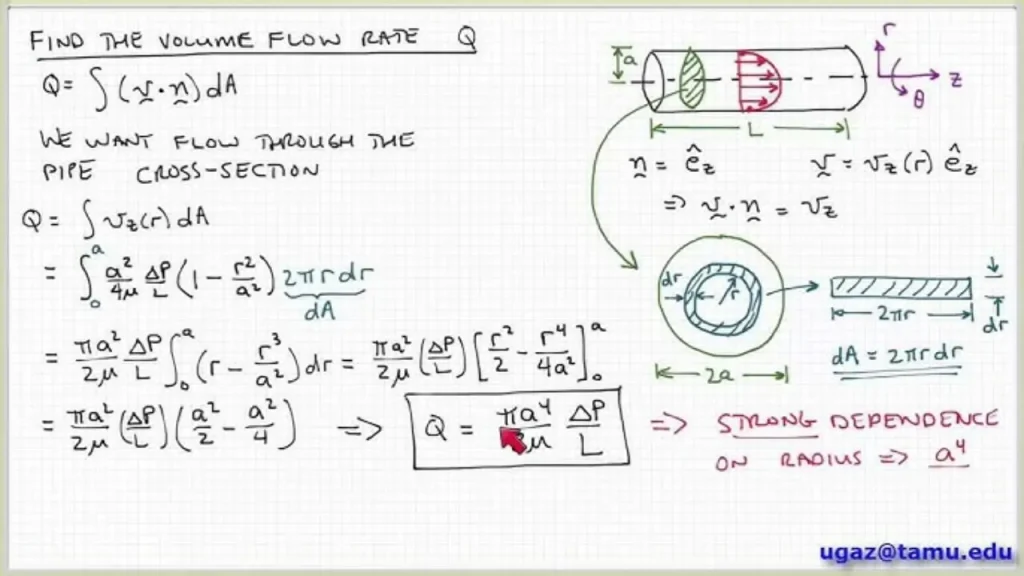
The central quantity is velocity. Imagine dividing a flowing liquid into countless tiny regions. Each region has a velocity, pressure, density, and other physical properties. The Navier–Stokes framework determines how those quantities interact. The equations essentially apply Newton’s second law—force equals mass times acceleration—to small portions of fluid while accounting for the way neighboring portions influence one another.
A common form for an incompressible Newtonian fluid can be written as:
ρ(∂u/∂t + u · ∇u) = −∇p + μ∇²u + f
along with the incompressibility condition:
∇ · u = 0
The symbols may look complicated, but each has a physical interpretation. Here, ρ represents fluid density, u is velocity, p is pressure, μ is dynamic viscosity, and f represents external forces such as gravity. The different terms describe acceleration, pressure forces, viscous effects, and applied forces.
Why the Equation Is Nonlinear
One of the most important features of Navier–Stokes is the nonlinear term u · ∇u. This term represents convection or advection: fluid moving through a region can transport momentum with it.
That seemingly modest feature creates enormous mathematical complexity. A change in velocity affects the fluid’s motion, which changes how momentum is transported, which then affects velocity again. The resulting interactions can become highly complicated, particularly when turbulence develops.
| Aspect | Navier Stokes Description |
|---|---|
| What it is | A set of partial differential equations used to describe fluid motion |
| Main purpose | Explains how fluids move under different forces and conditions |
| Developed by | Claude-Louis Navier and George Gabriel Stokes, building on earlier fluid mechanics |
| Applies to | Liquids and gases |
| Key variables | Velocity, pressure, density, viscosity, and external forces |
| Core principle | Conservation of momentum based on Newton’s laws |
| Viscosity | Represents a fluid’s resistance to deformation and flow |
| Pressure | Drives and influences fluid movement through pressure gradients |
| External forces | Can include gravity and other applied forces |
| Nonlinear term | The convection term creates complex interactions within the fluid |
| Turbulence | Can be modeled through Navier–Stokes, but turbulent flows are extremely difficult to solve exactly |
| Reynolds number | Helps compare inertial and viscous effects in a flow |
| Engineering uses | Aircraft, automobiles, pipelines, turbines, pumps, ventilation, and industrial systems |
| Medical uses | Modeling blood flow, respiratory airflow, and biological fluid systems |
| Environmental uses | Studying atmospheric circulation, rivers, oceans, and environmental flows |
| Computational use | Forms a foundation of computational fluid dynamics (CFD) |
| Mathematical challenge | Three-dimensional incompressible Navier–Stokes equations have an unresolved existence and smoothness problem |
| Millennium Prize | The existence and smoothness problem is one of the Clay Mathematics Institute’s Millennium Prize Problems |
| Difficulty | Mainly arises from nonlinear interactions, turbulence, and three-dimensional flow |
| Real-world importance | Helps scientists and engineers understand and predict how fluids behave |
The equations therefore do not simply tell us that water moves from one place to another. They describe a constantly evolving system in which different parts of a fluid influence one another. That interconnected behavior is a major reason fluid mechanics can be both extraordinarily useful and mathematically difficult.
2. The Physical Meaning of Pressure, Viscosity, and Flow
To understand Navier–Stokes intuitively, it helps to imagine pouring honey and water down the same inclined surface. Gravity pulls both fluids downward, but they respond differently. Water flows quickly and spreads readily, while honey resists deformation and moves much more slowly. The difference comes largely from viscosity.
Viscosity measures a fluid’s resistance to deformation or internal shearing. A highly viscous fluid, such as syrup, resists layers sliding past one another. A fluid with relatively low viscosity, such as air or water, offers less resistance. In the Navier–Stokes equations, viscosity appears through terms involving spatial changes in velocity.
Pressure provides another major influence. Fluid generally accelerates from regions of higher pressure toward regions of lower pressure, although the complete flow behavior depends on geometry, viscosity, boundaries, and other forces. In a pipe, for example, a pressure difference can drive water forward. Around an aircraft wing, variations in pressure are closely connected with the surrounding flow field and aerodynamic forces.
The Role of External Forces
External forces can also shape fluid motion. Gravity is an obvious example. It causes water to fall, contributes to atmospheric circulation, and affects fluids in tanks and reservoirs.
Other forces may appear in specialized situations. Electromagnetic forces can influence electrically conducting fluids. Rotating systems introduce effects associated with rotation. In engineering simulations, pumps, fans, moving surfaces, and mechanical components can all impose forces or boundary conditions that affect the fluid.
The beauty of the equations is that these influences can be represented within one mathematical framework. A problem may involve pressure, viscosity, gravity, geometry, and motion simultaneously. Solving the equations then reveals how the fluid responds.
Conservation Laws at the Foundation
Navier–Stokes equations are closely tied to fundamental conservation principles. Conservation of mass ensures that fluid is neither mysteriously created nor destroyed. Conservation of momentum accounts for how forces change fluid motion. Conservation of energy becomes important when temperature and heat transfer are included in a broader fluid model.
This connection to basic physical laws explains why the equations appear in so many disciplines. They are not an arbitrary mathematical construction. They emerge from principles that govern physical systems.
3. Navier Stokes and the Mystery of Turbulence
Turbulence is where fluid motion becomes especially fascinating. Consider smoke rising from a cigarette or chimney. At first, the smoke may form a relatively smooth column. A short distance upward, that column can begin to wobble, twist, break apart, and form swirling structures.
These irregular movements are not simply random noise. Turbulent flows contain structures and patterns across many different sizes and timescales. Large swirling motions can break into smaller ones, which interact with still smaller structures. Energy is transferred through this cascade until viscosity becomes significant at very small scales.
The Navier–Stokes equations can describe turbulent flow, but obtaining a direct and complete solution is extremely difficult. In practical engineering, scientists often use numerical methods and turbulence models to approximate the behavior rather than calculating every detail of every turbulent eddy.
Reynolds Number and Flow Behavior
One useful concept for understanding whether a flow is likely to be smooth or turbulent is the Reynolds number. It compares inertial effects with viscous effects.
A simplified expression is:
Re = ρUL/μ
where ρ is density, U is a characteristic velocity, L is a characteristic length, and μ is dynamic viscosity.
When inertial effects dominate strongly over viscous effects, disturbances can persist and grow more readily, making complex flow more likely. When viscous effects dominate, motion tends to be more strongly damped.
Reynolds number does not provide a universal switch that says “below this number flow is always smooth” and “above it flow is always turbulent.” Geometry and boundary conditions matter. Still, it is one of the most useful dimensionless quantities in fluid mechanics.
Why Turbulence Matters in Real Life
Turbulence is not merely a mathematical curiosity. It influences aircraft drag, fuel consumption, weather systems, ocean circulation, combustion, industrial mixing, and the performance of turbines.
For engineers, predicting turbulence accurately can save enormous amounts of money and time. A poor prediction of airflow around an aircraft can lead to inaccurate estimates of lift and drag. An inadequate model of flow inside a turbine can affect efficiency and component life.
This is one reason computational fluid dynamics has become so important. Modern computers can approximate Navier–Stokes solutions for remarkably complicated systems, even though the underlying mathematical questions remain challenging.
4. How Navier Stokes Equations Are Used in Science and Engineering
The practical reach of Navier–Stokes is enormous. In aerospace engineering, computational models use fluid equations to examine airflow around wings, fuselages, engines, and spacecraft. Engineers can investigate pressure distributions, aerodynamic drag, flow separation, and other effects before building expensive physical prototypes.
Automotive engineers use similar methods to study airflow around cars. A vehicle’s shape determines how air moves around it, and that flow influences drag, stability, cooling, and fuel or energy efficiency. Computer simulations allow designers to test numerous shapes and configurations much faster than building a full-scale physical model for every experiment.
The equations are equally valuable in civil and mechanical engineering. Water distribution systems, pumps, turbines, ventilation equipment, heating systems, and industrial pipelines all involve fluid motion. Engineers need to understand pressure losses, flow rates, velocity profiles, and forces acting on surfaces.
Applications in Medicine and Biology
Fluid mechanics also plays an important role in medicine. Blood is a complex biological fluid moving through an intricate network of vessels. Mathematical models can help researchers study blood flow, pressure changes, and the relationship between vessel geometry and fluid behavior.
The cardiovascular system is particularly interesting because real blood is not always perfectly represented by the simplest Newtonian-fluid assumptions. Vessel walls can deform, blood contains cells, and flow conditions can vary significantly. More advanced models therefore combine fluid mechanics with biological and mechanical information.
Similar principles apply to respiratory airflow. Air moving through the nose, throat, lungs, and airways can be studied using computational fluid dynamics. Such simulations may help researchers investigate airflow patterns, medical devices, and the transport of particles or medications.
Weather, Oceans, and the Atmosphere
The atmosphere is also a fluid system. Winds, pressure differences, convection, and large-scale circulation are governed by fluid dynamics, although atmospheric models incorporate additional equations for temperature, moisture, radiation, Earth’s rotation, and other processes.
Ocean modeling presents another enormous application. Currents transport heat, nutrients, salt, and other materials around the planet. Understanding these flows requires sophisticated mathematical and computational models.
In these applications, Navier–Stokes is rarely used alone. It forms part of larger systems of equations that describe the physical processes relevant to the particular problem. Even so, its fundamental role in representing fluid momentum remains central.
5. Why the Navier Stokes Millennium Problem Is So Difficult
The practical success of Navier–Stokes might make it seem strange that mathematicians still regard the equations as an unsolved problem. The difficulty lies not in writing the equations down but in proving that their solutions behave in a mathematically controlled way.
For three-dimensional incompressible Navier–Stokes equations, one major unresolved question concerns existence and smoothness. Roughly speaking, mathematicians want to know whether starting from sufficiently smooth initial conditions always produces a solution that remains smooth for all future time, or whether the equations could develop a singularity in finite time.
A singularity would represent a point where quantities associated with the mathematical solution become unbounded or otherwise lose the required regularity. Proving that such a breakdown can never occur—or demonstrating that one can occur—would settle the problem.
Why Three Dimensions Change Everything
Two-dimensional fluid models are mathematically better behaved in several important respects. Three-dimensional flow introduces another direction in which structures can stretch, twist, and interact.

A useful way to visualize the challenge is to imagine a tiny vortex in a fluid. In three dimensions, the vortex can be stretched by the surrounding flow. Vortex stretching can redistribute energy and amplify complex structures. Capturing the long-term consequences of these interactions is one of the central mathematical difficulties.
The nonlinear nature of the equations makes this even harder. Small changes in the velocity field can influence later motion in complicated ways, and the resulting feedback can span many scales.
A Problem With a Famous Prize
The Navier–Stokes existence and smoothness problem is one of the Millennium Prize Problems established by the Clay Mathematics Institute. A correct mathematical solution carries a $1 million prize.
The prize is not offered because Navier–Stokes has no practical solutions. Engineers and scientists solve approximate versions of these equations every day. Instead, the challenge concerns a rigorous mathematical proof about the fundamental behavior of the equations themselves.
That distinction is important. Numerical simulations can provide powerful evidence about fluid behavior, but numerical evidence is not the same as a proof that applies to every allowable initial condition. A mathematical solution must establish its claims with rigorous reasoning.
The problem illustrates an intriguing feature of mathematics: an equation can be extraordinarily successful in describing the physical world while still containing deep unanswered questions about its theoretical foundations.
Conclusion
The Navier Stokes equations sit at the heart of modern fluid mechanics. They provide a mathematical language for describing how liquids and gases move under the influence of pressure, viscosity, external forces, and their own changing momentum.
Their importance extends far beyond textbooks. Aircraft design, automobile engineering, weather prediction, ocean modeling, industrial machinery, medical research, and countless other fields depend on understanding fluid motion. Computational fluid dynamics has transformed the way engineers approach these problems, allowing complex flows to be studied with remarkable detail.
At the same time, the equations remain a source of profound mathematical uncertainty. The three-dimensional existence and smoothness problem asks whether smooth solutions can remain well behaved for all time. Despite enormous progress in mathematical analysis and computational science, the central question remains open.
That combination makes Navier–Stokes particularly remarkable. They are practical enough to help design aircraft and understand atmospheric circulation, yet mysterious enough to challenge some of the world’s finest mathematicians. Few equations manage to connect everyday physical phenomena with one of the deepest unanswered problems in mathematics.
10 Frequently Asked Questions About Navier Stokes
1. What are the Navier Stokes equations?
The Navier–Stokes equations are partial differential equations that describe the motion of fluids. They account for factors such as velocity, pressure, viscosity, density, and external forces.
2. Who developed the Navier Stokes equations?
The equations developed through contributions from several scientists, particularly Claude-Louis Navier and George Gabriel Stokes. Their work built on earlier developments in fluid mechanics and Newtonian mechanics.
3. What types of fluids can Navier Stokes describe?
The equations can be applied to many liquids and gases. Their simplest common form describes Newtonian fluids, in which viscosity has a relatively straightforward relationship with the rate of deformation.
4. Why are the Navier Stokes equations difficult to solve?
The equations contain nonlinear terms that cause different parts of a fluid to interact in complicated ways. Turbulence can create structures across many scales, making exact analytical solutions extremely difficult for realistic three-dimensional flows.
5. What is the Navier Stokes Millennium Problem?
It is a mathematical problem concerning the existence and smoothness of solutions to the three-dimensional incompressible Navier–Stokes equations. Mathematicians want to determine whether suitable smooth initial conditions always lead to globally smooth solutions.
6. Are the Navier Stokes equations actually used in engineering?
Yes. They are fundamental to computational fluid dynamics and are used in fields including aerospace, automotive engineering, mechanical engineering, environmental science, and energy systems.
7. What is viscosity in the Navier Stokes equations?
Viscosity describes a fluid’s resistance to deformation and internal flow. Honey has much greater viscosity than water, which is why it flows much more slowly under comparable conditions.
8. What does the Reynolds number tell us?
The Reynolds number compares inertial effects with viscous effects in a fluid flow. It is commonly used to help characterize whether flow conditions favor smooth or turbulent behavior, although geometry and other factors also matter.
9. Can computers solve the Navier Stokes equations?
Computers can numerically approximate solutions to many Navier–Stokes problems. Sophisticated computational fluid dynamics methods can model extremely complicated flows, although numerical approximations do not resolve every mathematical question about the equations.
10. Why are Navier Stokes important?
They provide one of the central mathematical frameworks for understanding fluid motion. Their applications range from aircraft and engines to weather, oceans, industrial systems, and biological flows, while their unresolved mathematical properties continue to inspire fundamental research.navier stokes
