


Introduction
A geomagnetic storm begins far from Earth, often with an eruption on the Sun, yet its consequences can reach directly into the systems people depend on every day. A burst of solar material can travel across space and collide with Earth’s magnetic environment, disturbing the invisible shield surrounding our planet. The result may be anything from spectacular auroras dancing across the night sky to temporary problems involving satellites, radio communications, navigation systems, and electrical infrastructure.
These storms are a fascinating reminder that Earth is not isolated from the activity of its parent star. The Sun constantly releases solar wind, but powerful eruptions can dramatically change the conditions in near-Earth space. When those changes interact with Earth’s magnetosphere in the right way, energy is transferred into the system and produces what scientists call a geomagnetic storm.
Understanding these events has become increasingly important because modern society relies heavily on technology operating both on the ground and in space. Satellites guide navigation, support communications, monitor weather, and provide essential data for countless industries. At the same time, electrical grids stretch across enormous distances and can respond to changing magnetic conditions. A geomagnetic storm therefore represents much more than an astronomical curiosity; it is a natural phenomenon with practical consequences.
1. What Is a Geomagnetic Storm?
A geomagnetic storm is a significant disturbance in Earth’s magnetosphere caused by changes in the solar wind and interplanetary magnetic field. The magnetosphere is the enormous magnetic region surrounding Earth, created primarily by our planet’s magnetic field. It acts as a protective barrier against much of the solar wind, but it is not an impenetrable wall. When the solar wind becomes particularly energetic or its magnetic field has an orientation that allows efficient energy transfer, Earth’s magnetic environment can become highly disturbed.
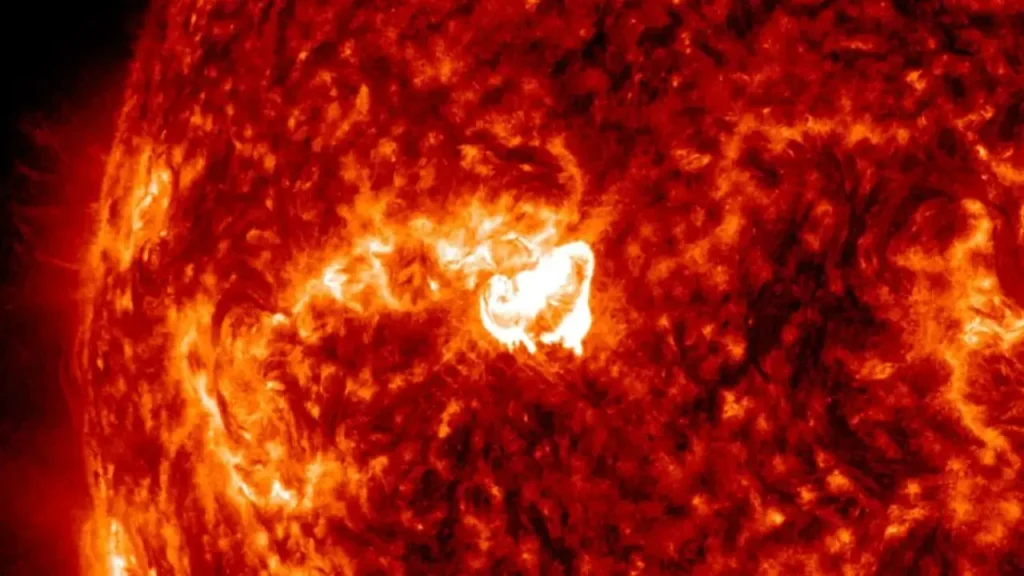
One of the most important triggers is a coronal mass ejection, commonly called a CME. A CME is a huge eruption of magnetized plasma from the Sun. If a CME is directed toward Earth, it can take anywhere from roughly 15 hours to several days to arrive, depending on its speed. High-speed solar wind streams associated with coronal holes can also produce geomagnetic activity without a dramatic CME.
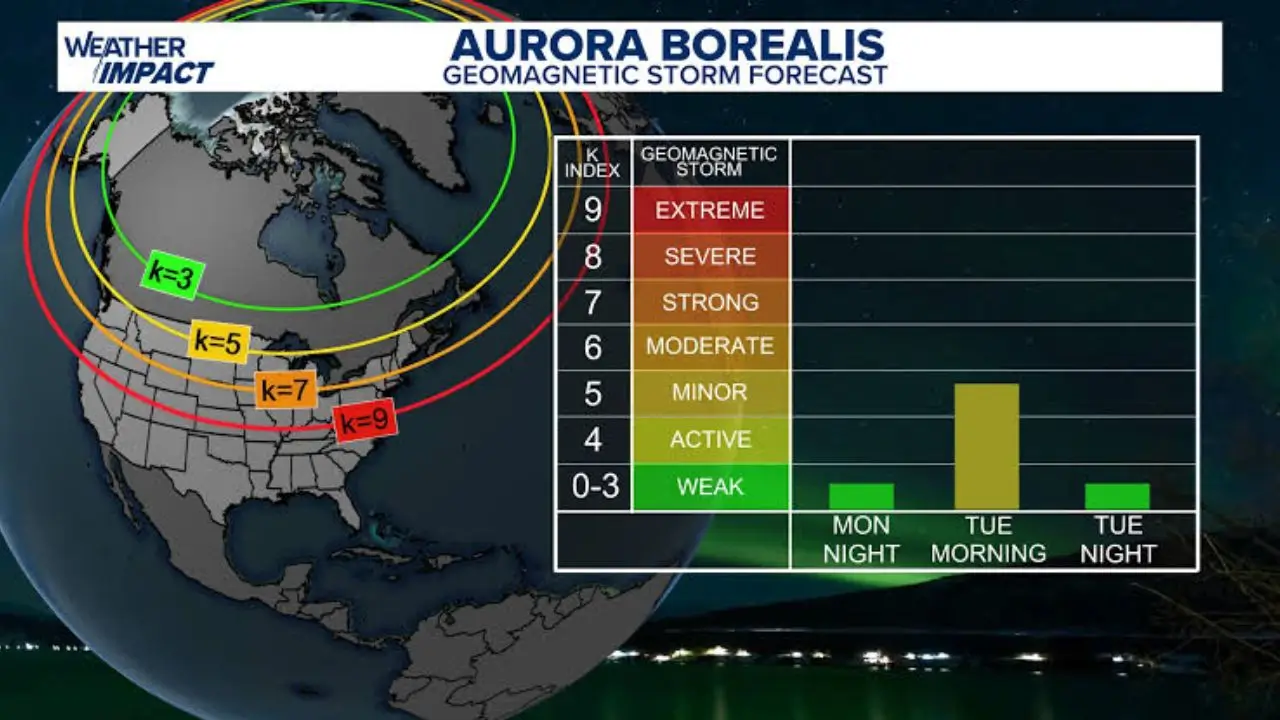
The interaction becomes particularly effective when the magnetic field carried by the incoming solar wind points southward relative to Earth’s magnetic field. Under those circumstances, magnetic reconnection can allow substantial amounts of energy to enter the magnetosphere. Currents develop throughout the magnetosphere and upper atmosphere, producing changes that can eventually be measured at Earth’s surface. Scientists use several indicators to understand these disturbances, including the Kp index, which forms the basis of NOAA’s G-scale for geomagnetic storms.
It is worth separating geomagnetic storms from other kinds of solar activity. A solar flare, for example, is an intense burst of electromagnetic radiation, while a solar radiation storm involves elevated levels of energetic particles. These phenomena can occur together, but they are not interchangeable. A geomagnetic storm specifically describes the disturbance of Earth’s magnetic environment.
2. What Causes a Geomagnetic Storm?
The Sun is constantly active. Its surface and atmosphere contain powerful magnetic fields that can become twisted, concentrated, and unstable. When magnetic energy is suddenly released, the Sun can produce flares and launch enormous clouds of plasma into space. Some of those eruptions travel away from the Sun without affecting Earth, while others happen to be directed toward our planet. Whether an eruption produces a major geomagnetic storm depends on factors such as its speed, direction, magnetic structure, and the conditions it encounters along the journey.
CMEs are among the most significant sources of major geomagnetic storms. They carry both charged particles and magnetic fields. When a powerful CME reaches Earth’s magnetosphere, its arrival can compress the magnetosphere and generate a chain of physical responses. The resulting currents and changes in the upper atmosphere can last for hours and, during stronger events, may continue considerably longer.
High-speed solar wind streams provide another pathway. These streams often originate from coronal holes, regions where magnetic field lines extend outward from the Sun. The solar wind flowing from such regions can be much faster than the surrounding solar wind. When fast and slow streams interact, they can create compressed regions capable of disturbing Earth’s magnetic environment.
Why the Sun’s Activity Matters
Solar activity follows a broad cycle of approximately 11 years, moving between periods of lower and higher activity. Around solar maximum, the Sun generally produces more sunspots and has a greater likelihood of generating eruptions capable of creating significant space-weather events. That does not mean a severe geomagnetic storm occurs every time the Sun becomes active. The eruption must have the right trajectory and magnetic characteristics to produce a substantial disturbance at Earth.
| Aspect | Details |
|---|---|
| What is a geomagnetic storm? | A temporary disturbance of Earth’s magnetic field caused by strong solar activity. |
| Main cause | Coronal mass ejections (CMEs) and high-speed solar wind streams. |
| Source | The Sun, particularly regions with intense magnetic activity. |
| Main affected area | Earth’s magnetosphere, ionosphere, satellites, and some electrical infrastructure. |
| Most visible effect | Bright auroras, including the northern and southern lights. |
| Effect on GPS | Can temporarily reduce positioning accuracy because of ionospheric disturbances. |
| Effect on radio | Can disrupt or weaken some high-frequency radio communications. |
| Effect on satellites | Increased radiation and atmospheric drag can interfere with satellite operations. |
| Effect on power grids | Strong storms can create geomagnetically induced currents in long transmission lines. |
| Human health risk | Generally low for people on Earth’s surface because of atmospheric and magnetic protection. |
| High-risk environments | Space missions and some high-altitude aviation operations can require additional precautions. |
| Comm |
Scientists therefore monitor the Sun continuously. Space-based observatories can watch for solar eruptions, measure solar radiation, and observe structures moving outward from the Sun. Once a CME is detected, researchers can model its potential path and estimate when it might arrive near Earth. Forecasting remains challenging, however, because some of the most important magnetic properties of a CME are difficult to determine until the structure is measured closer to Earth.
3. How Geomagnetic Storms Affect Earth and Modern Technology
For people standing on Earth’s surface, a geomagnetic storm may seem harmless, especially because our atmosphere and magnetic field provide substantial protection from solar activity. Yet the same event can have serious implications for technological systems. One major concern is the electrical power grid. Rapid changes in Earth’s magnetic field can induce electrical currents in long conductors such as transmission lines. These geomagnetically induced currents can place additional stress on transformers and other grid equipment.
The severity depends on the strength and duration of the storm as well as local geological and electrical conditions. During an extreme event, some power systems could experience voltage-control problems, protective-system issues, and potentially widespread outages. NOAA classifies geomagnetic storms from G1, considered minor, through G5, considered extreme. A G5 event can produce major disruptions to power systems and may damage transformers under unfavorable conditions.
Satellites face a different collection of challenges. Geomagnetic storms heat Earth’s upper atmosphere, causing it to expand. Satellites operating in low Earth orbit can consequently encounter greater atmospheric drag. That additional drag changes their orbits and can complicate tracking and maneuver planning. Spacecraft can also experience charging and other operational problems during strong disturbances.
Navigation systems can also be affected. GPS and other global navigation satellite systems rely on radio signals passing through the ionosphere. Storm-driven changes in the ionosphere can alter the path and behavior of those signals, reducing positioning accuracy or causing intermittent problems. This matters not only to smartphones but also to aviation, shipping, surveying, agriculture, construction, and other industries that depend on precise positioning.
Radio communication is another vulnerable area. Strong geomagnetic activity can disturb the ionosphere and affect high-frequency radio propagation. This can be particularly important for aviation and other operations that rely on radio communications over long distances. NOAA’s highest storm category warns of the possibility of severe high-frequency radio problems and significant navigation degradation.
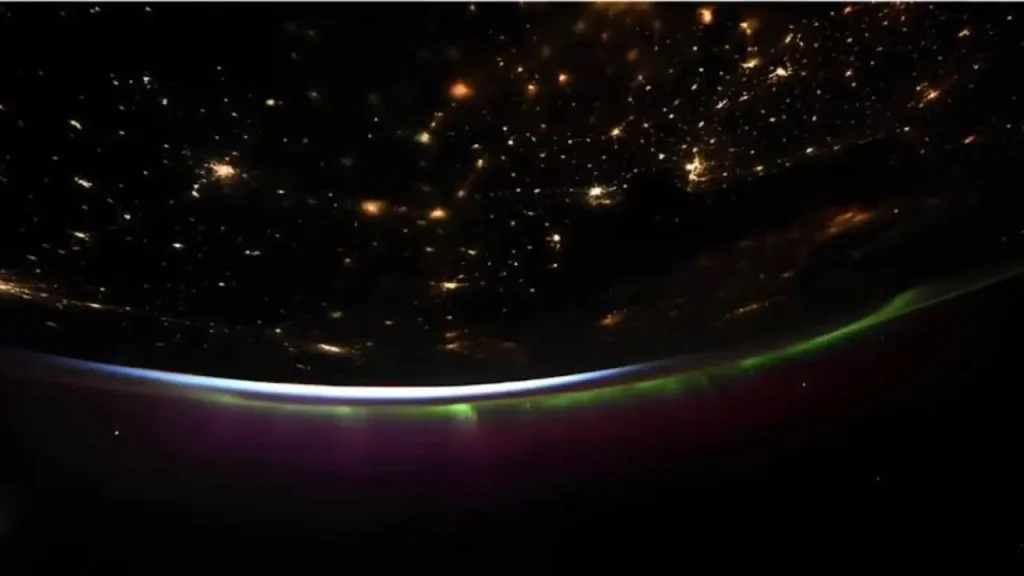
Yet the effects are not universally destructive. One of the most beautiful consequences of geomagnetic activity is the aurora. When energetic particles enter Earth’s upper atmosphere along magnetic field lines, they interact with atmospheric gases and release energy in the form of light. The familiar northern lights, or aurora borealis, and southern lights, or aurora australis, are the visible result. During powerful storms, auroras can appear much farther from the polar regions than they normally do.
4. Understanding the G-Scale: From G1 to G5
Not every geomagnetic storm is equally powerful. NOAA uses a five-level G-scale to communicate the strength and potential effects of geomagnetic disturbances. The system runs from G1, minor, to G5, extreme. The classification is closely related to the planetary K-index, or Kp, which is used to describe disturbances in Earth’s magnetic field.
A G1 storm corresponds to a Kp value of 5. It can cause weak fluctuations in power grids and minor effects on satellite operations. Auroras may become visible at relatively low latitudes compared with their usual locations. G1 storms are not exceptionally rare when considered over an entire solar cycle.
At G2, corresponding to Kp 6, the effects become more noticeable. High-latitude power systems can experience voltage alarms, while spacecraft operators may need to make adjustments. Increased atmospheric drag can also affect orbital predictions. Auroras may become visible considerably farther south than usual in the Northern Hemisphere.
A G3 storm, associated with Kp 7, is considered strong. Satellite navigation can experience intermittent problems, radio communication can be affected, and electrical systems may face greater stress. At G4, the storm is classified as severe, with the potential for significant disruptions to power systems, spacecraft operations, satellite navigation, and radio communications.
The top category, G5, is extreme. NOAA describes the possibility of widespread voltage-control and protective-system problems, with some grid systems potentially experiencing collapse or blackouts. Satellite operators can face problems involving orientation, communications, and tracking. High-frequency radio propagation may become severely disrupted, satellite navigation can be degraded for days, and auroras can sometimes be seen at unusually low geomagnetic latitudes.
That scale should not be interpreted as a prediction that every storm at a particular level will produce exactly the same consequences everywhere. Geography, infrastructure design, storm duration, local geology, satellite orbit, and other factors all influence the actual outcome. A storm rating provides a useful common language, but real-world impacts require additional analysis.
5. How Scientists Monitor and Forecast Geomagnetic Storms
Predicting a geomagnetic storm begins with watching the Sun. Scientists track sunspots, solar flares, coronal mass ejections, coronal holes, and changes in solar wind conditions. Spacecraft positioned between Earth and the Sun can provide valuable measurements of incoming solar wind and magnetic-field conditions before those disturbances reach Earth.
Forecasting a CME is particularly challenging. Scientists can often identify an eruption and estimate whether its trajectory could intersect Earth, but determining the exact intensity of the resulting geomagnetic storm is harder. A CME’s internal magnetic structure plays a crucial role, and some of its most important characteristics cannot be measured accurately until the CME gets much closer to Earth.
Once solar material reaches monitoring spacecraft near Earth, conditions can be measured directly. Solar-wind speed, magnetic-field strength, and the north-south orientation of the magnetic field provide important information about the storm’s potential. The Kp index is then used to characterize the broader geomagnetic response and support alerts and warnings.
Why Early Warning Matters
Early warning gives satellite operators, power companies, aviation authorities, and other organizations time to prepare. Spacecraft teams can modify operations, review satellite pointing plans, and account for changing atmospheric drag. Power-grid operators can monitor vulnerable equipment and take precautionary steps when conditions warrant.
For ordinary people, preparation is generally much simpler. A geomagnetic storm does not mean that people on the ground should panic or expect immediate danger. The primary concerns involve technological infrastructure rather than direct physical effects on most people at Earth’s surface. Strong solar events can pose greater radiation concerns for astronauts and certain high-altitude aviation operations, but Earth’s atmosphere provides substantial protection to people on the ground.
Perhaps the most useful response for the public is simply to understand the difference between a fascinating space-weather event and a catastrophic scenario. Most geomagnetic storms do not cause widespread disaster. Many are modest and primarily noticeable to scientific instruments or specialized technological systems. The strongest events are rare, but their potential consequences are serious enough that governments, researchers, satellite operators, and utility companies continue investing in monitoring and forecasting.
Conclusion
A geomagnetic storm is a powerful demonstration of the connection between the Sun and Earth. What begins as activity millions of kilometers away can eventually disturb Earth’s magnetic field, heat the upper atmosphere, alter satellite orbits, interfere with navigation and radio signals, and place stress on electrical infrastructure. At the same time, the same physical processes can create some of nature’s most spectacular sights, turning ordinary night skies into displays of green, red, purple, and sometimes blue light.
The science behind these storms is complex, but the basic story is surprisingly easy to understand: the Sun releases energy and magnetized material, that material travels through space, and Earth’s magnetic environment responds when conditions are right. Modern forecasting allows scientists to watch this chain of events and provide warnings before the most significant effects arrive.
As technology becomes more deeply integrated into everyday life, understanding space weather becomes increasingly valuable. A geomagnetic storm is not simply a disturbance in space. It is part of a much larger relationship between our planet and the star that powers it.
10 Frequently Asked Questions About Geomagnetic Storms
1. What is a geomagnetic storm?
A geomagnetic storm is a major disturbance in Earth’s magnetic environment caused by changes in the solar wind and interplanetary magnetic field. Powerful CMEs and high-speed solar wind streams are common triggers.
2. What causes a geomagnetic storm?
The most powerful storms are often caused by coronal mass ejections, which send magnetized plasma from the Sun toward Earth. High-speed solar wind streams from coronal holes can also create geomagnetic disturbances.
3. Can a geomagnetic storm damage a phone?
A typical geomagnetic storm is unlikely to directly damage an ordinary smartphone. However, severe space-weather events can interfere with satellite navigation, communications, and other infrastructure that phones depend on.
4. Can geomagnetic storms cause power outages?
Yes. Strong geomagnetic storms can induce electrical currents in long power-transmission lines. In extreme circumstances, these currents can contribute to voltage problems, equipment stress, and power outages.
5. Are geomagnetic storms dangerous to humans?
For most people on the ground, Earth’s atmosphere and magnetic field provide substantial protection from space-weather effects. The greatest direct radiation concerns involve astronauts and, under certain circumstances, high-altitude aviation crews and passengers during significant solar radiation events.
6. Can a geomagnetic storm affect GPS?
Yes. Geomagnetic storms can disturb the ionosphere, which can change the propagation of satellite navigation signals. The result may be reduced positioning accuracy or intermittent navigation problems.
7. Why do geomagnetic storms create auroras?
Energetic particles associated with geomagnetic activity can travel along Earth’s magnetic field lines and interact with gases in the upper atmosphere. These interactions release energy as visible light, producing auroras.
8. What is the strongest geomagnetic storm category?
The strongest category on NOAA’s geomagnetic storm scale is G5, classified as extreme. It can be associated with serious impacts on power systems, satellites, navigation, radio communications, and other technologies.
9. How long does a geomagnetic storm last?
The duration varies considerably. Some disturbances are relatively brief, while major geomagnetic storms can continue for many hours or even longer as the solar wind and Earth’s magnetic environment remain disturbed.
10. Can scientists predict geomagnetic storms?
Scientists can often detect solar eruptions and estimate whether they may affect Earth, but predicting the exact strength of a resulting storm remains difficult. Measurements of the solar wind and magnetic field close to Earth greatly improve forecasts and allow warnings to be issued when conditions become threatening
