


Introduction
The latest iran war news points to a conflict that has moved far beyond a direct confrontation between two or three governments. The war has affected shipping lanes, energy markets, military bases, neighboring countries, and diplomatic efforts across the Middle East. As of October 8, 2026, tensions remain extremely high, with renewed concerns that major military operations could intensify. Reports indicate that Washington is considering possible strike options against Iran, while Tehran has warned that any new attack could trigger a stronger response.
The situation is particularly difficult to understand because several developments are unfolding at the same time. Military activity is occurring alongside diplomatic efforts, while attacks and threats involving shipping in the Strait of Hormuz are creating economic pressure far beyond the region. Recent reports also show increased activity involving Iran-aligned groups in Yemen and continuing concerns about attacks on U.S. and regional interests.
For readers trying to follow the conflict, the most useful approach is to separate confirmed developments from political claims and predictions. The battlefield situation can change quickly, and statements from governments involved in the conflict often present events from very different perspectives. Understanding the broader picture therefore requires looking at military developments, diplomacy, energy security, and the humanitarian consequences together.
The Current State of the Iran Conflict
The current conflict has entered a prolonged and dangerous phase. Reuters reports that the U.S.-Iran war began on February 28, 2026, and has continued for months despite periods of diplomatic activity and attempts to establish a political settlement. A provisional peace effort in June failed to produce a lasting agreement, leaving fundamental disagreements unresolved.
One of the central disputes is Iran’s nuclear program. The United States is demanding major restrictions on Iran’s enrichment capabilities and wants Tehran to reduce or potentially eliminate its stockpile of highly enriched uranium. Iranian officials, however, continue to argue that the country’s right to nuclear enrichment cannot simply be removed through external pressure. That disagreement has become one of the biggest obstacles to a durable settlement.
Why the Situation Remains Unstable
The conflict is also complicated by uncertainty surrounding political decision-making in Tehran. U.S. President Donald Trump recently questioned who is effectively running Iran, reflecting wider uncertainty about Iran’s leadership structure during the prolonged war. At the same time, Iranian officials have continued issuing statements about resistance, military preparedness, and the future of the country’s nuclear program.
Iran’s nuclear chief, Mohammad Eslami, said on October 8 that Iran’s nuclear sector was continuing to expand despite sanctions, attacks, and international pressure. Such statements demonstrate why negotiations remain difficult: Washington sees restrictions on enrichment as central to security, while Tehran continues to describe its nuclear activities as an area of national sovereignty and technological development.
| Item | Details |
|---|---|
| SEO Title | iran war news: Latest Developments, Regional Tensions, and What Comes Next |
| Meta Title | iran war news: Latest Conflict Updates and Key Developments |
| Meta Description | iran war news covers the latest conflict developments, military tensions, diplomacy, oil markets, and regional security concerns. |
| Slug | iran-war-news |
| Category | News |
| Focus Keyword | iran war news |
| Article Length | 1400+ words |
| H2 Headings | 6 |
| FAQs | 10 |
There is also the possibility of renewed U.S. military action. Reports published October 8 said the White House had asked the Pentagon to prepare options for potential strikes against Iran, although no final decision to launch such an operation had been announced. The reported planning has increased concerns that the conflict could enter another major phase.
The Strait of Hormuz Has Become a Major Flashpoint
One of the most important developments in the latest Iran war news is the growing danger around the Strait of Hormuz, a narrow waterway through which enormous quantities of energy products move between the Persian Gulf and global markets. Any serious disruption there can quickly affect oil prices, shipping costs, insurance premiums, and transportation networks around the world.
Recent shipping data shows that traffic through the strait has fallen sharply. Reuters reported that seven commodity vessels crossed the waterway on Tuesday, the lowest daily number since July 23. Crude shipments through Hormuz were also reported to have fallen 27% from the previous week’s wartime high to approximately 10.1 million barrels per day.
The decline is closely connected to the growing danger faced by commercial vessels. Reuters reported that at least 12 tanker-related incidents occurred between September 28 and October 5, making that the most active week for attacks, attempted attacks, and harassment of tankers since the war began. The incidents included drone activity and aggressive communications involving Iran’s Revolutionary Guards.
Why Oil Prices Are Rising
The consequences are already visible in energy markets. Brent crude rose above $100 per barrel on October 8, with Reuters reporting a price of $105.20 during the day’s trading. Concerns over attacks on shipping, Middle Eastern supply disruptions, and wider geopolitical instability have combined to push prices higher.
The economic impact does not stop at the price of crude oil. Higher energy costs can increase transportation expenses, manufacturing costs, airline operating expenses, and household fuel bills. Shipping companies may also introduce emergency surcharges when operating through high-risk areas. Maersk, for example, announced an emergency fuel surcharge of 20% for certain shipments beginning October 12, citing the continuing Middle East conflict.
That makes the Strait of Hormuz more than a regional military concern. Its security has become an international economic issue. Even if the majority of oil continues to move through alternative routes or remains available, uncertainty itself can push prices upward because companies and governments must prepare for possible shortages.
Regional Expansion Is Making the War More Dangerous
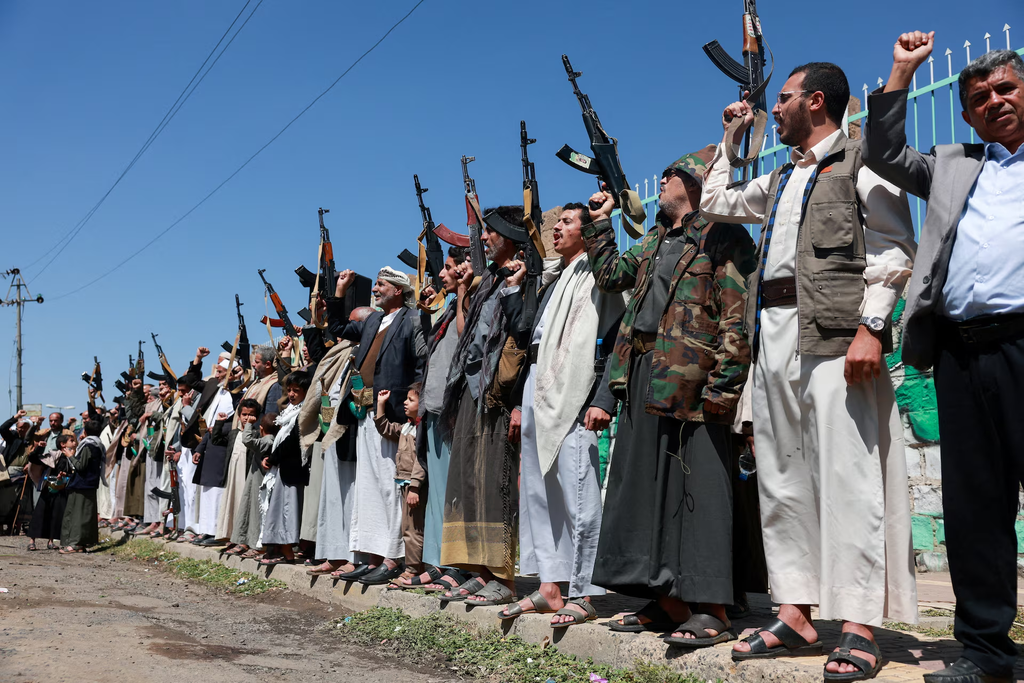
The conflict is no longer confined to the immediate U.S.-Iran confrontation. Yemen has become another important front, particularly because Iran-backed Houthi forces have continued attacks against Saudi targets and other regional interests. Reuters reported that the Houthis claimed responsibility for a ballistic missile attack against King Khalid International Airport in Riyadh on October 8, following another reported attack that Saudi authorities said had killed one person.
The renewed fighting in Yemen has serious strategic implications. The country sits near the Bab el-Mandeb Strait, another major maritime route connecting the Red Sea with the Gulf of Aden. Increased fighting there can force shipping companies to reconsider routes, increase security expenses, or avoid certain waters entirely.
Reuters has described the renewed Yemen fighting as an explosive new front in the wider regional conflict. Saudi Arabia has become directly involved again against Houthi forces, while Iranian support for the Houthis remains a major concern. The combination of Yemen’s difficult terrain, divided political factions, and established Houthi military capabilities makes a quick resolution unlikely.
The Risk of a Wider Regional War
A major concern for governments throughout the region is that individual confrontations could become connected. An attack in one country could produce retaliation somewhere else, creating a chain reaction that becomes increasingly difficult to control.
The recent attacks around shipping routes illustrate this danger. A conflict involving Iran, the United States, and Israel can quickly create consequences for Saudi Arabia, Yemen, Iraq, Kuwait, Qatar, the United Arab Emirates, and international shipping companies. Military planners therefore have to consider not only direct attacks but also responses from regional groups aligned with Iran.
This is one reason diplomacy remains important even when military rhetoric becomes aggressive. A broader regional war could be far more expensive and destructive than the original confrontation, particularly if major energy infrastructure or shipping routes are deliberately targeted.
Diplomacy, Nuclear Negotiations, and the Search for an Exit
Despite the military escalation, diplomacy has not disappeared. Iranian and American officials have continued sending messages through intermediaries, while regional governments have attempted to prevent the conflict from becoming permanent.
Iran has previously presented conditions for ending hostilities that included reopening the Strait of Hormuz and removing sanctions. The United States, meanwhile, has continued to emphasize restrictions on Iran’s nuclear enrichment program. The two sides remain separated by fundamental disagreements over security guarantees, sanctions, enrichment rights, and the political future of the conflict.
Diplomacy is particularly complicated because neither side wants to appear weak. For Iran, accepting severe restrictions without meaningful guarantees could be portrayed domestically as surrendering under military pressure. For Washington, accepting a deal that does not substantially limit Iran’s nuclear capabilities could create political and security problems at home.
What Could Create a Breakthrough?
A sustainable agreement would probably need to address several issues simultaneously rather than focusing on only one. Nuclear restrictions could be linked to sanctions relief, while maritime security arrangements could be used to reduce pressure around the Strait of Hormuz.
Verification would also be critical. Any nuclear agreement would need mechanisms that allow international inspectors and governments to establish whether commitments are actually being followed. Without credible verification, even a signed agreement could collapse quickly.
Another major issue is trust. The current conflict has produced enormous damage and deepened suspicion between the parties. That means even technically workable proposals may fail if either side believes the other intends to use negotiations simply to gain time for another military operation.
The latest reports suggest that diplomacy is competing against growing military pressure. U.S. officials continue to demand significant changes from Tehran, while Iranian officials warn that renewed attacks would provoke retaliation.
Humanitarian and Economic Consequences of the War
Behind military statements and oil prices are millions of people affected by the conflict. Prolonged warfare places enormous pressure on civilian populations, particularly through damage to infrastructure, economic disruption, displacement, and uncertainty about basic services.
The economic effects inside Iran have become increasingly severe. Iranian lawmakers have reported that alternative import routes are raising transportation expenses and increasing the prices of various goods. When major ports or shipping routes become difficult to use, even products that remain physically available can become more expensive because moving them requires longer and more complicated supply chains.
Businesses face similar problems. Importers must deal with higher insurance costs, uncertain delivery schedules, currency pressure, and restrictions connected to sanctions. Small businesses can be especially vulnerable because they usually have fewer financial reserves and less flexibility to change suppliers.
The conflict is also affecting countries outside Iran. Higher energy prices can feed into inflation, while expensive shipping can raise the cost of imported goods. Airlines and logistics companies may have to alter routes, and governments can face pressure to protect consumers from rising fuel costs.
The Human Cost Beyond Iran
The humanitarian consequences extend across the region. Yemen, in particular, is experiencing renewed displacement as fighting between Saudi-backed forces and the Houthis intensifies. Recent reporting has highlighted major population displacement and continuing attacks affecting civilian infrastructure.
There is also a growing risk to civilians simply because the number of military fronts is increasing. When missiles, drones, aircraft, and naval forces operate across multiple countries, the possibility of mistakes or unintended casualties rises.
For ordinary families, the conflict is not defined by military maps. It is experienced through missing relatives, interrupted flights, expensive food, fuel prices, school closures, damaged homes, and uncertainty about what will happen tomorrow.
That human dimension is often overlooked when attention focuses entirely on strategic victories and military capabilities. Yet it may ultimately determine the political pressure placed on governments to find a settlement.
What Could Happen Next?
The immediate future of the conflict remains uncertain. One possible path is renewed large-scale U.S. military action against Iran. Reports that the Pentagon has been asked to prepare strike options demonstrate that this possibility is being actively discussed, although preparation does not mean a final decision has been made.
A second possibility is another attempt at negotiations. The economic costs of the war are growing, and both sides have reasons to avoid an unlimited conflict. Iran faces continuing economic and military pressure, while the United States must consider the financial cost, regional consequences, and domestic political impact of prolonged warfare.
A third possibility is a prolonged low-intensity conflict. Instead of one decisive military campaign, the region could experience recurring attacks, limited strikes, maritime incidents, cyber operations, sanctions, and diplomatic pauses. Such a situation would remain dangerous because every new incident could trigger another escalation.
The Strait of Hormuz will be especially important. If shipping continues to decline and tanker attacks increase, pressure on governments to secure the waterway will grow. On the other hand, if commercial traffic gradually returns to normal, it could provide an important signal that regional tensions are beginning to stabilize.
The nuclear issue will remain equally significant. Iran’s continued insistence on its enrichment rights and Washington’s demand for substantial restrictions leave little room for a simple compromise. A durable settlement will likely require concessions from both sides, credible verification, and security arrangements that can survive political changes.
Conclusion
The latest iran war news shows a conflict that has developed into a much wider geopolitical and economic crisis. Military confrontation remains possible, but the consequences are already being felt through disrupted shipping, rising oil prices, regional fighting, economic pressure, and humanitarian uncertainty. The Strait of Hormuz has become one of the most sensitive points in the crisis, while Yemen has emerged as another dangerous front.
The biggest question is no longer simply who can win a particular battle. It is whether the United States, Iran, and their regional partners can prevent the conflict from expanding into an even larger war. Diplomacy remains difficult, but the alternative—a prolonged confrontation involving multiple countries and critical energy routes—could carry enormous costs.
For readers following the conflict, the most reliable approach is to distinguish confirmed developments from political claims and predictions. The situation is changing rapidly, and statements made by governments or military organizations should be assessed carefully. What happens next will depend on decisions made in Washington, Tehran, Jerusalem, and across the Gulf, but the effects will be felt far beyond the Middle East.
10 Frequently Asked Questions
1. What is the latest Iran war news?
As of October 8, 2026, tensions remain high, with reports that the United States is considering military strike options against Iran. Shipping activity through the Strait of Hormuz has also fallen significantly amid increased attacks and threats against tankers.
2. Is the United States planning another attack on Iran?
Reports indicate that the White House has asked the Pentagon to prepare possible strike options. However, preparation of military options does not mean that President Donald Trump has made a final decision to launch another major operation.
3. Why is the Strait of Hormuz so important?
The Strait of Hormuz is a major global energy corridor. Large quantities of oil and other energy products pass through it, so disruption can quickly affect fuel prices, shipping costs, and global markets.
4. Are oil prices being affected by the Iran conflict?
Yes. Oil prices have risen sharply amid concerns about tanker attacks, possible supply disruptions, and broader instability in the Middle East. Brent crude moved above $100 per barrel on October 8.
5. What is the main disagreement between Iran and the United States?
One of the biggest disagreements concerns Iran’s nuclear program. Washington wants significant restrictions on Iran’s enrichment capabilities, while Tehran continues to defend its right to nuclear enrichment.
6. Is Yemen involved in the Iran conflict?
Yemen has become an important part of the wider regional conflict. Iran-backed Houthi forces have carried out attacks against Saudi targets, while Saudi Arabia has intensified military operations against the Houthis.
7. Are ships still traveling through the Strait of Hormuz?
Yes, commercial traffic has continued, but the number of vessels has fallen considerably. Shipping data reported by Reuters showed seven commodity vessels crossing on Tuesday, the lowest daily figure since July 23.
8. How is the war affecting ordinary people?
The conflict is contributing to higher prices, disrupted transportation, increased economic uncertainty, and displacement. In Iran, lawmakers have reported higher import costs as goods are redirected through alternative routes.
9. Could the Iran war become a larger regional conflict?
Yes. The involvement of Iran-aligned groups, fighting in Yemen, attacks affecting Gulf countries, and threats against shipping create multiple opportunities for escalation. A single major incident could potentially trigger retaliation across several fronts.
10. Could diplomacy still end the Iran war?
Diplomacy remains possible, although major disagreements make an agreement difficult. A lasting settlement would likely need to address Iran’s nuclear program, sanctions, maritime security, and guarantees concerning future military action.
